HSSB 4041
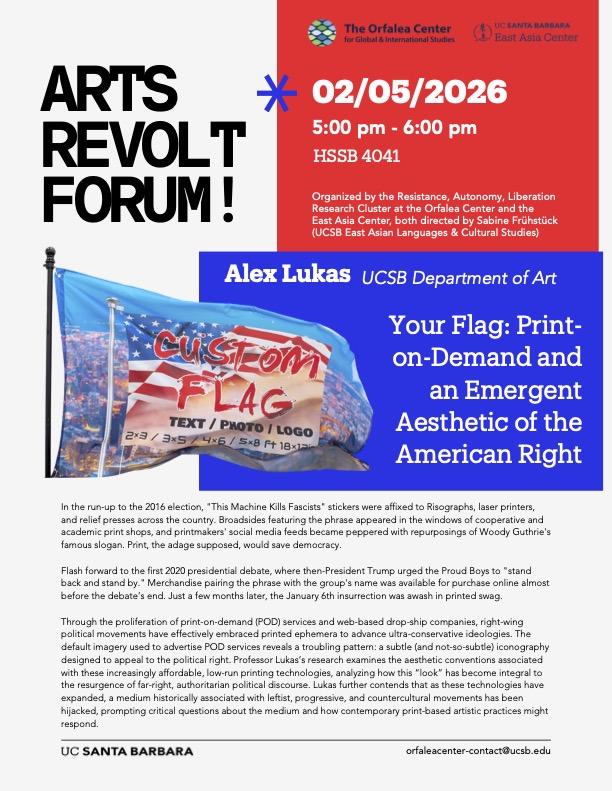
In the run-up to the 2016 election, "This Machine Kills Fascists" stickers were affixed to Risographs, laser printers, and relief presses across the country. Broadsides featuring the phrase appeared in the windows of cooperative and academic print shops, and printmakers' social media feeds became peppered with repurposings of Woody Guthrie's famous slogan. Print, the adage supposed, would save democracy. Flash forward to the first 2020 presidential debate, where then-President Trump urged the Proud Boys to "stand back and stand by." Merchandise pairing the phrase with the group's name was available for purchase online almost before the debate’s end. Just a few months later, the January 6th insurrection was awash in printed swag.Through the proliferation of print-on-demand (POD) services and web-based drop-ship companies, right-wing political movements have effectively embraced printed ephemera to advance ultra-conservative ideologies. The default imagery used to advertise POD services reveals a troubling pattern: a subtle (and not-so-subtle) iconography designed to appeal to the political right. Professor Alex Lukas’s research examines the aesthetic conventions associated with these increasingly affordable, low-run printing technologies, analyzing how this “look” has become integral to the resurgence of far-right, authoritarian political discourse. Lukas further contends that as these technologies have expanded, a medium historically associated with leftist, progressive, and countercultural movements has been hijacked, prompting critical questions about the medium and how contemporary print-based artistic practices might respond.
Alex Lukas was born in Boston, Massachusetts, and raised in nearby Cambridge. With a wide range of influences, Lukas’ practice focuses on the intersections of place and human activity, narrative, and history. His fieldwork, research, and production reframe the incidental and the monumental through intricate publication series, sculptures, drawings, prints, audio collages, and experimental curatorial platforms. Lukas’ work has been exhibited widely and is included in the collections of the Pennsylvania Academy of the Fine Arts, the Kadist Foundation, the MIT List Visual Arts Center Student Lending Art Collection, the Philadelphia Museum of Art, and the libraries of the Museum of Modern Art, New York, the San Francisco Museum of Modern Art, the National Gallery in Washington D.C., amongst other institutions. He has been awarded residencies at the Bemis Center for the Arts, the Center for Land Use Interpretation, and the Kohler Arts/Industry program. He was named one of the University of California Regents’ Humanities Faculty Fellows in support of his most recent curatorial project, Public Texts: A Californian Visual Language, a multi-faceted exhibition and public art initiative presented at the AD&A Museum in the spring of 2025. Lukas graduated with a BFA from the Rhode Island School of Design and received his MFA from Carnegie Mellon University. He currently serves as an Associate Professor of Print and Publication in the Department of Art at the University of California, Santa Barbara.